


Many parents of autistic kids later discover their own neurodivergence.
Many don’t.
Many are somewhere in between, like “huh… interesting.”
And all of it is valid.
Radical acceptance is never tidy
When I sat down with Julie M Green, we weren’t just two writers, or two mothers raising autistic kids. We’re two friends trying to retroactively make sense of childhoods that never fit, and adulthood that finally does. Our conversation was full of grace, messiness, humor, and recognition.
A Conversation About Autism, Motherhood, and Radical Acceptance
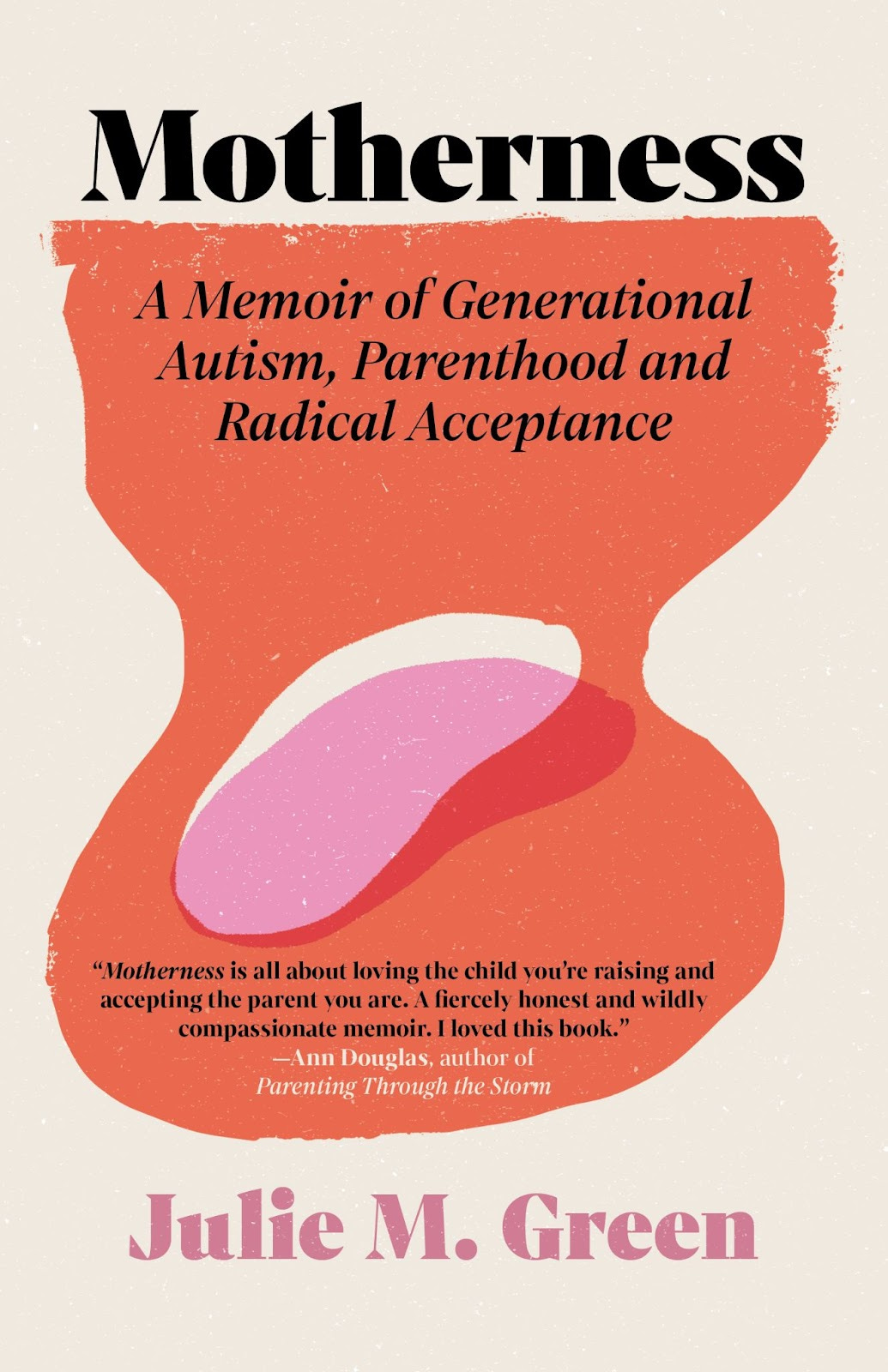
Julie wrote her memoir, Motherness: A Memoir of Generational Autism, Parenthood, and Radical Acceptance, with humor, honesty, tenderness and insight. I opened our conversation by reading a passage I loved. It’s a little window into her teenage self:
“In 1984, while everyone was busy fawning over a dancer named Madonna, I mooned over another pop singer, Cyndi Lauper… If Cyndi was so unusual, then so was I.”
Julie laughed: “It wasn’t as cool as I wanted it to be.”
When Autism Runs in the Family
‘Motherness’ alternates between scenes from her childhood and scenes from raising her son, who she calls Carson.
“My son was diagnosed when he was three. Back in 2012, it was a very different scene. I knew nothing about autism other than Rain Man.”
It took nearly a decade before Julie recognized her own neurodivergence — a gap familiar to so many women who grew up masking and surviving. When she finally got her diagnosis, there was an explosion of clarity.
“You expect it, but you also don’t expect it. You start looking back and suddenly think, ‘Oh, that’s what happened. That’s what that was.’”
In our first interview, Julie spoke in-depth about her diagnosis process:

The structure of Motherness mirrors that process: alternating chapters between her childhood, young adulthood, and the early years of parenting her son. She wrote the book she wished she’d had.
Honest Talk About Raising Aggressive Kids
We talked about aggression — something many parents are scared to mention publicly, for fear of judgment or harming our child’s reputation.
One scene in Motherness hit me like a punch: A new start in an idyllic neighborhood, children playing… and then the heartbreak of something unraveling. Many of us have had that moment: when the dream version of parenthood collides with reality, and you feel the loneliness of being the only one dealing with this.
It can be hard for people to feel empathetic when a child is lashing out. But it’s all variations of the same thing: dysregulation.
Even within the autism community, there are layers of invisibility.
Julie said:
“Not everyone talks about aggression. So many people are dealing with this, but no one talks about it.”
In Motherness, Julie talks about it. With tenderness, honesty, and zero sensationalism.
A Balanced Yet Cathartic Narrative
Julie said:
“I processed as I was writing. Some parts were so hard to write — scenes from my childhood or early parenting — but also cathartic… I wanted to create a more balanced narrative. Not tragedy. Not superpower. Something real. Something human.”
I told her how rare that is, especially in autism memoirs, where stories often skew toward either devastation or inspiration. Motherness refuses both.
Autism Isn’t a Tragedy or a Superpower, It’s a Constellation
Julie talked about the ongoing debate over levels, categories, functioning labels.
“There shouldn’t be this hierarchy. They’re just different needs… A lot of the needs are toward mental health… If someone’s suicidal or aggressive, those are serious needs too. They’re just different.”
This conversation felt like a permission slip for parents who feel unseen in both directions — judged for their child’s struggles, or dismissed because their child masks well. Julie holds the full complexity without flattening it into inspiration porn. In fact, she was intentional about including humor:
“Autism isn’t a tragedy, and it’s not a superpower. Our lives are complicated. Some days are really hard. Some days are hilarious… I didn’t want doom and gloom. I wanted balance.”
Generational Loneliness That Echoes
I shared that parts of her memoir reminded me of the loneliness I felt growing up, and how that loneliness got re-triggered when my own kid struggled socially.
“The loneliness I felt as a child came roaring back when my son was rejected. It felt like it was happening to me all over again.”
Julie responded:
“It’s weird how we revisit childhood through our kids. I didn’t realize why his social struggles triggered me so deeply…


The Pressure to Always Be Steering Our Kids
We both reflected on early intervention culture and the pressure to fix, fix, fix. When Julie talked about the early years, she said:
“I felt so much was on my shoulders. If I just worked hard enough… if I just did all the things… then he’d be okay.”
I think every parent of a neurodivergent child has felt swallowed by that pressure. Julie shared about a video she found years later, of her playing imaginatively with her son:
“What should have been a sweet moment — I could see I was working on him. Steering him. Trying to therapize him. It made me so sad.”
We both took a deep breath. Because we’ve both been there.
A Shift Toward Connection and Maturity
Now, Julie said:
“I’ve relaxed so much. I try to enjoy him more, connect more. I let him in on my own challenges. I don’t pretend parents have it all figured out.”
And I told her: That’s growth mindset in action. That’s modeling what we want our kids to internalize.
Julie agreed:
“We butt heads sometimes. We both need routine, we both get rigid, but I’m upfront about my challenges. It helps us find our way.”

Little Glimmers Everywhere
When I asked Julie for a parenting memory that brings her joy, she didn’t go grand.
She shared a moment that encapsulates the everyday magic she writes about:
“Last night, he was about to study for a test and we both started singing this 1960s song — ‘the birds and the bees, the flowers and the trees.’ We danced around the kitchen arm-in-arm. Five minutes later he was back to studying.
“Those little glimmers are everything.”
For neurodivergent families who find big events overwhelming, joy comes from the pressure-free moments. (For Ocean and I, it’s cooking together.)
What Julie Wants Parents to Know
“Don’t get bogged down in fear or worry. We can’t predict the future. Take the pressure off yourself. Enjoy your kids. Connect with them. Even with a teenager, the bond evolves, and it’s really cool.”
I added:
“Self-compassion makes room for joy. When we soften toward ourselves, those glimmers show up more often.”
Read Motherness by Julie M. Green
Julie’s book shares truths so many of us are desperate to feel reflected.
If you’re a parent of a neurodivergent kid, a late-identified autistic adult, or someone who has ever felt like the “weird one,” reading this memoir will help you feel seen. It’s tender, funny, sharp, reflective, and beautifully honest.
(Also — the cover is deliciously tactile. Truly a sensory pleasure.)
Substack: Julie M Green
Memoir: Motherness
Instagram: juliem.green
If you’re reading Motherness or thinking about it, tell us in the comments.
If you’ve had a glimmer lately, we’d love to hear that too!
A kinder future for our kids begins with kindness toward ourselves.


